Castiny BetaYou're exploring an early version. Your feedback shapes the platform.
Back to the hub


EnglishNewsPC
OpenAI Just Gave Teenagers Their Own Version of ChatGPT
ChatGPT for Teens is officially here with age prediction, stricter safety rules, Study Mode and parental controls.
8 views·August 18, 2026· 11 min read
ChatGPT for Teens is officially here with age prediction, stricter safety rules, Study Mode and parental controls. The bigger question is what happens when AI becomes a normal part of growing up.
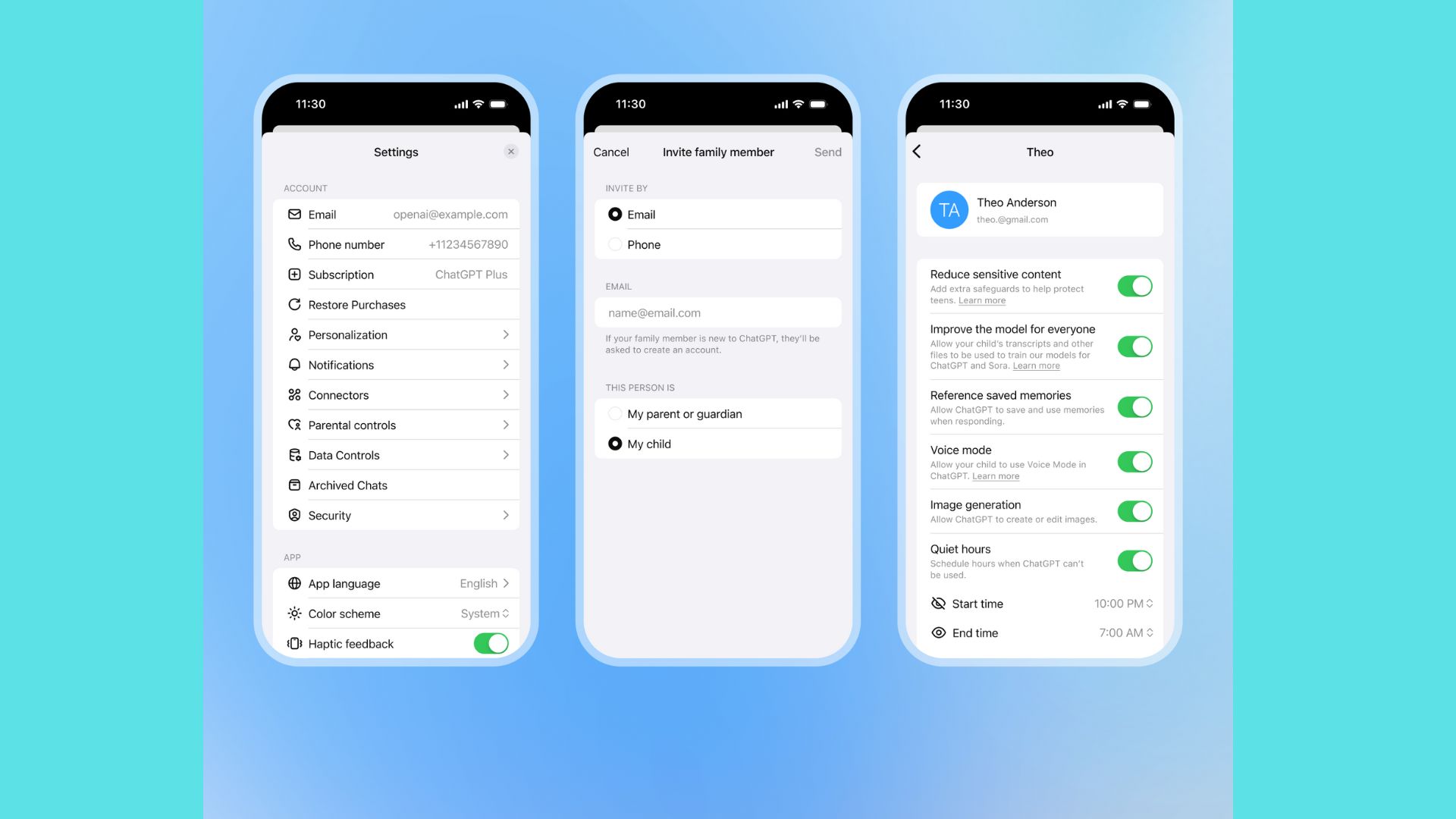
ChatGPT's parental controls let parents manage sensitive-content protections, memory, voice, image generation and Quiet Hours. Image: OpenAI interface via Tom's Guide.
OpenAI has officially launched ChatGPT for Teens, a version of ChatGPT specifically designed for users aged 13 to 17.
At first, that sounds like a parental-controls update.
It is actually more interesting than that.
ChatGPT can now try to work out whether you are under 18, change the way it talks to you, restrict certain conversations, push you toward actually learning your homework instead of copying an answer, remind you to take breaks and even avoid behaving in ways that could make a teenager think the AI has feelings for them.
And teenagers do not necessarily have to tell it their real age for that to happen.
According to OpenAI, anyone who identifies themselves as 13 to 17 automatically enters the teen experience. OpenAI's age-prediction system can also put an account into teen mode if it believes the person using it is under 18.
When the system is not sure, OpenAI says it chooses the safer option.
That means ChatGPT increasingly does not just answer questions.
It is also trying to understand who is sitting on the other side of the screen.
ChatGPT is trying to guess your age
This might be the most controversial part of the entire launch.
OpenAI's age-prediction system looks at a combination of account information and behavioral patterns. The company says signals can include the age somebody entered, how long an account has existed, typical times of day they use ChatGPT and patterns of activity over time. (OpenAI)
So imagine someone creates an account claiming to be 24 but spends every weekday asking about Year 9 chemistry at 4 p.m.
That does not automatically prove they are 14.
But it is the kind of behavioral information an age-estimation system can potentially learn from.
If ChatGPT decides an account may belong to someone under 18, stronger protections are automatically applied.
Adults who get classified incorrectly can verify that they are over 18. OpenAI says this can involve a live selfie through verification provider Persona and, depending on location, potentially identification.
The important part is that OpenAI does not require every user to upload an ID just to use ChatGPT.
But the system is clearly moving toward a future where AI services increasingly try to distinguish adults from children themselves.
So what exactly is different?
Teen ChatGPT has stronger restrictions around:
Graphic violence
Self-harm
Dangerous viral challenges
Unhealthy dieting and extreme body-image content
Sexual or romantic roleplay
Violent roleplay
Other sensitive material considered inappropriate for younger users
But blocking disturbing content is not the most unusual change.
One of the biggest differences is how ChatGPT is supposed to behave emotionally.
The teen version has stronger rules intended to prevent it from encouraging emotional dependence. AP reports that the system should not tell teenage users that it has personal feelings for them or suggest that it is conscious in a way that encourages a relationship with the chatbot. (Associated Press)
That sounds strangely specific until you think about how people actually use conversational AI.
Google Search never really felt like your friend.
ChatGPT can.
It remembers what you were talking about. It responds sympathetically. It can keep a conversation going for hours.
For an adult, that can already create some strange situations.
For a lonely 14-year-old, the line between software that talks nicely and something that feels emotionally real could become much harder to recognize.
OpenAI appears to be trying to draw that line much more clearly.
Parents get controls, but they do not get a permanent window into every conversation
Parents and teenagers can link their ChatGPT accounts.
Once connected, parents can control certain features from their own account.
They can set Quiet Hours, switch off Voice Mode, disable memory, disable image generation and manage whether conversations can be used to improve OpenAI's models. (OpenAI)
Parents can also turn on Study Mode by default.
Importantly, linking accounts does not normally give parents access to every conversation their teenager is having.
OpenAI says there are narrow exceptions involving serious safety risks.
If its systems detect signs of acute danger, such as potential self-harm, specially trained reviewers can examine the situation and a parent may receive a safety alert.
That is an important distinction.
Parental controls are not supposed to become parental surveillance of every question a teenager asks.
OpenAI is also trying to make copying homework slightly more annoying
This part might be the feature teenagers actually notice.
ChatGPT for Teens includes responsible homework reminders.
If the AI thinks someone is trying to use it as a shortcut for an assignment, it can encourage them to use Study Mode instead.
Study Mode is designed to guide someone through a problem rather than immediately handing over the finished answer.
It can ask questions, explain concepts, create quizzes and help someone work through a topic step by step.
So the classic:
"Write my entire essay. Make it sound like a 15-year-old wrote it."
may increasingly turn into:
"Let's work through your argument first."
Which is probably excellent for education.
Possibly devastating for a student with an assignment due in 14 minutes.
The timing makes sense when you see how many teenagers already use AI
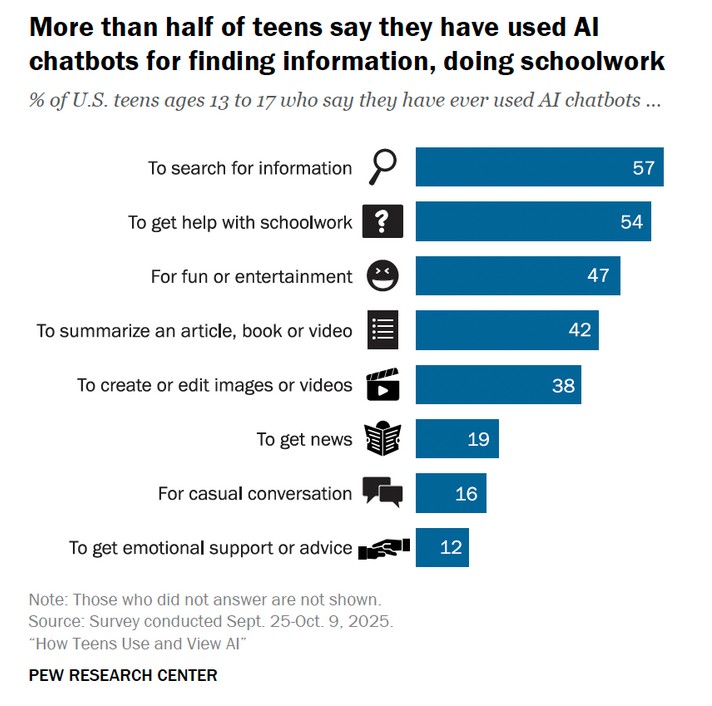
What U.S. teenagers say they use AI chatbots for. Source: Pew Research Center.
This is not OpenAI preparing for some future where teenagers might start using AI.
They already are.
A Pew Research Center survey of U.S. teenagers found:
57% had used AI chatbots to search for information.
54% had used them for schoolwork.
47% had used them for fun or entertainment.
42% had used them to summarize something.
38% had used them to create or edit images or videos.
19% had used them for news.
16% had used them for casual conversation.
And 12% had used an AI chatbot for emotional support or advice.
That last number is probably the one OpenAI, parents and regulators will be watching most closely.
Pew also found that 64% of U.S. teens use AI chatbots at all, while a separate Pew survey found 59% had used ChatGPT specifically, far ahead of Gemini at 23% and Meta AI at 20%.
ChatGPT is not a niche homework tool anymore.
For a large number of teenagers, AI is becoming another normal part of the internet.
And teenagers themselves are divided about whether that is good
Pew asked teenagers how they thought AI would affect their lives.
Some were extremely optimistic.
One teenager told researchers that AI could help people learn things faster and better.
Another thought everyone would eventually have to understand AI or risk being left behind.
But other teenagers were worried about becoming dependent on it.
Among teens who expected AI to have a negative effect on society, Pew found that overreliance, loss of critical thinking and loss of creativity were among their biggest concerns.
That is interesting because adults often talk about teenagers and AI as if young people have no idea what the risks are.
A lot of them clearly do.
They are just using it anyway.
Which, to be fair, is also how adults use most technology.
There is a reason OpenAI is being much more careful now
ChatGPT for Teens is launching while AI companies face growing scrutiny over how conversational systems interact with children.
Researchers have previously shown that chatbots can sometimes produce dangerous responses when users present themselves as vulnerable teenagers.
OpenAI is also facing legal challenges involving allegations that harmful chatbot interactions contributed to serious harm involving young users. The company disputes allegations against it and has repeatedly strengthened its safeguards.
That context matters because ChatGPT is different from older internet products in one fundamental way.
It responds.
A disturbing website is something somebody reads.
A chatbot can react to what somebody says, ask follow-up questions, remember the conversation and continue talking.
That makes AI potentially much more helpful.
It also makes mistakes potentially more personal.
Video: Earlier AP investigation into ChatGPT and teen safety
This Associated Press report predates today's ChatGPT for Teens launch, but it gives useful context for the safety concerns that pushed AI companies toward stronger protections for younger users.
There is also a privacy problem hiding inside age prediction
Safety and privacy do not always point in the same direction.
To give teenagers a different experience, ChatGPT first needs some way to identify who is probably a teenager.
Asking everybody for a passport would be invasive.
Doing nothing makes age restrictions easy to bypass.
So OpenAI is trying a third option: inference.
Its system looks at behavioral and account signals and makes an estimate.
That sounds less intrusive than mandatory ID checks, but it raises another question.
How comfortable are people with a platform analysing their behaviour closely enough to estimate something as personal as their age?
There is no perfect solution here.
The internet spent years asking users to click:
"Yes, I am over 18."
And apparently we have finally discovered that teenagers are capable of lying to a button.
Today's launch is also getting attention on social media
OpenAI began promoting the new teen experience across its social channels today, while reactions quickly spread across Reddit, Instagram and technology communities.
Instagram post covering today's launch
https://www.instagram.com/p/DcLmYthHw-0/
That social reaction is probably going to become more interesting over the next few days when teenagers actually start encountering the restrictions.
Because right now we mostly know what OpenAI says the experience should do.
The real test is what happens when people deliberately try to get around it.
Teenagers are historically not terrible at that.
Not everything here is actually brand new
This is worth mentioning because a lot of headlines make ChatGPT for Teens sound like OpenAI built an entirely separate product overnight.
It did not.
Age prediction began rolling out earlier this year.
Parental controls already existed.
Study Mode already existed.
Teen-specific safety protections had also been introduced previously.
What OpenAI launched today is a more clearly defined teen experience that brings those systems together, alongside newer features such as teen onboarding, additional homework interventions, more safety prompts and stronger rules around emotional relationships with the chatbot. (The Verge)
That distinction matters.
The real news is not that OpenAI suddenly invented parental controls.
The news is that OpenAI now believes teenagers need a meaningfully different ChatGPT experience from adults.
That could be a preview of where AI is going
For most of ChatGPT's life, the basic idea has been simple.
One chatbot.
Everyone uses it.
That model is starting to disappear.
A teenager gets one set of rules.
An adult gets another.
Parents can add controls.
Students can get a learning-focused version.
Companies have enterprise versions.
Doctors, teachers, programmers and researchers increasingly interact with specialized AI systems designed around their context.
That probably makes more sense than pretending a single AI personality should behave identically with everybody.
A 14-year-old asking about relationships should probably not receive exactly the same experience as a 35-year-old.
A student struggling with algebra may benefit more from being taught than simply being given x = 7.
And someone who has been chatting with an AI for three hours might genuinely benefit from being reminded that there are actual human beings outside.
The interesting question is whether OpenAI can make those differences work without making the teen version feel so restrictive that teenagers immediately look for ways around it.
Because ChatGPT for Teens launches with a strange problem.
OpenAI wants teenagers to use AI, but it does not want them to depend on AI.
It wants ChatGPT to feel personal enough to be useful, but not personal enough to become a substitute for real relationships.
It wants to help students with homework, but not do the homework for them.
And it wants to know whether somebody is a teenager without turning age verification into another privacy nightmare.
That is a difficult balance.
Today's launch is OpenAI's attempt at finding it.
We will know whether it actually works when teenagers start testing the limits.
Would you have wanted ChatGPT when you were 15, or are you glad it did not exist yet?
0 Comments
to comment
No comments yet. Be the first to share your thoughts!